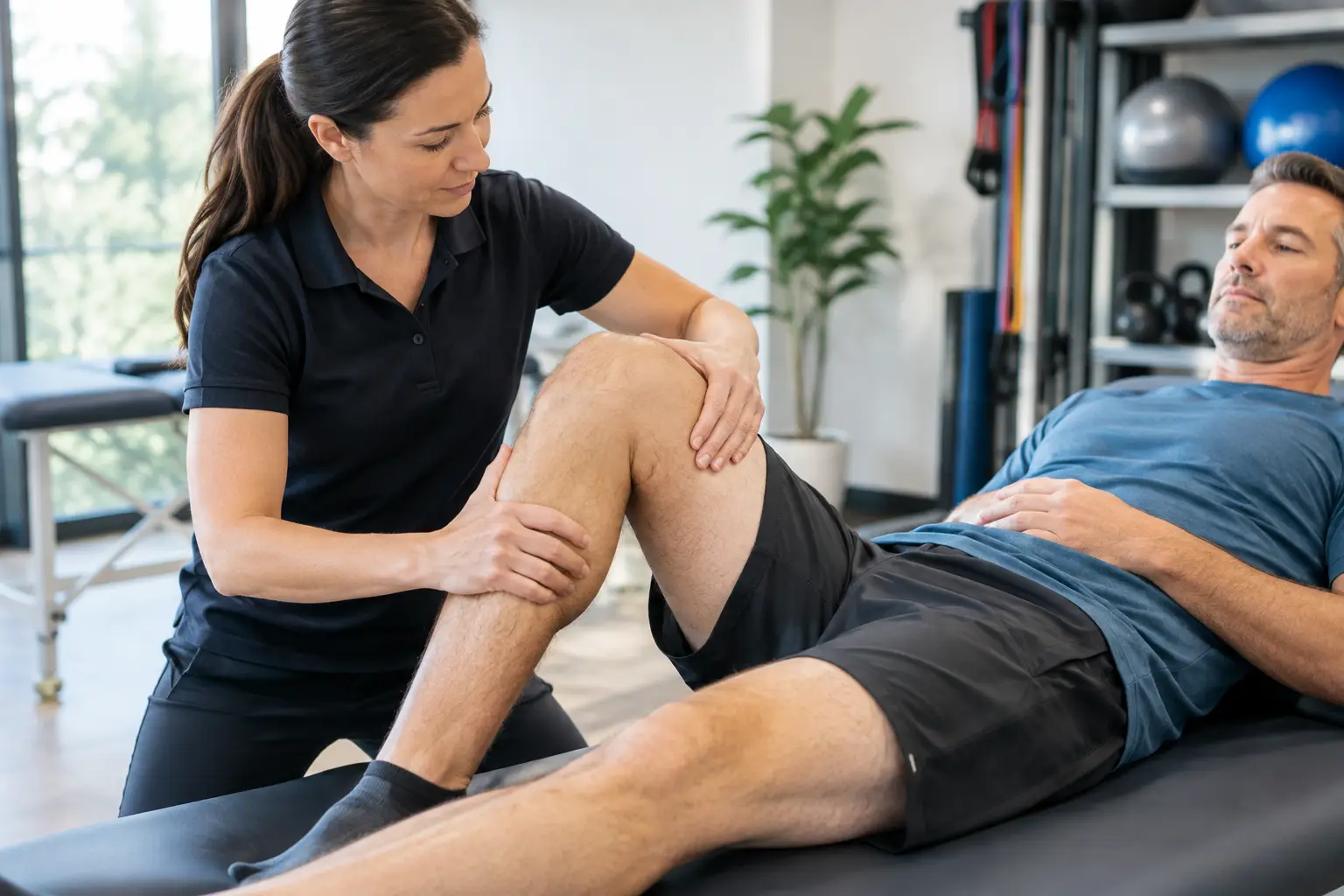
A knee that hurts when you squat, climb stairs, pivot, or get up after sitting does not automatically point to one diagnosis. Meniscus tear versus knee arthritis is a common question because both can cause stiffness, swelling, reduced confidence, and a frustrating drop in activity. The key difference is rarely one isolated symptom. It is the pattern of symptoms, how they started, what your knee can tolerate, and what a thorough assessment finds.
For active adults in Hamilton, the practical question is usually not, “What is the perfect label?” It is, “Why does my knee hurt now, what can I safely keep doing, and what needs to change so this stops limiting my training, work, sport, or daily life?”
Meniscus tear versus knee arthritis: what is different?
The meniscus is a tough, rubber-like piece of cartilage that sits between the thigh bone and shin bone. Each knee has an inner and outer meniscus. They help distribute load, improve joint stability, and protect the joint surfaces during walking, running, lifting, and twisting.
A meniscus tear occurs when part of that tissue is damaged. It can happen suddenly during a twist, deep squat, awkward landing, or contact injury. It can also develop gradually as the tissue changes with age and repeated loading. A scan may show a meniscus tear in someone with knee pain, but that does not prove the tear is the sole source of symptoms. Meniscal changes are common, particularly after midlife, including in people without pain.
Knee arthritis, usually knee osteoarthritis, involves changes to the whole joint rather than one isolated structure. Cartilage, bone, the joint lining, surrounding muscles, and the nervous system can all influence symptoms. Arthritis is not simply “bone on bone,” and an X-ray does not measure how capable or painful a knee will be. Some people with obvious X-ray changes remain highly active, while others have significant symptoms with less visible change.
These conditions can also coexist. A person may have arthritis-related joint changes and a degenerative meniscus tear. That is why a plan based only on imaging can miss the bigger picture.
Symptom patterns that can offer clues
A traumatic meniscus tear often starts with a memorable event: a planted twist in hockey, a turn while carrying something at work, or a deep loaded squat that produces immediate pain. Swelling may develop over the next several hours or by the next day. Pain is often felt along the inner or outer joint line and may be sharper with twisting, pivoting, kneeling, or deep bending.
Some people describe catching, clicking, or a feeling that the knee does not fully straighten. Clicking alone is not a reliable sign of a serious tear. True mechanical locking is different: the knee is physically blocked and cannot fully bend or straighten. That deserves prompt assessment, particularly after an injury.
Knee arthritis often has a more gradual onset. The knee may ache after longer walks, standing shifts, stairs, hills, repeated squatting, or getting moving after prolonged sitting. Stiffness after rest is common, but it typically improves as the knee warms up. Symptoms may fluctuate. A busy weekend, a jump in running volume, or several days spent kneeling at work can create a flare-up without causing new structural damage.
There is substantial overlap. Both conditions can cause swelling, pain on stairs, loss of bend, and discomfort with squatting. Arthritis can produce clicking, and a meniscal tear can cause an ache rather than a sharp pain. Trying to diagnose yourself based on one symptom usually creates more uncertainty than clarity.
What can aggravate each problem?
With an irritated meniscus, loaded twisting and deep knee flexion are frequent aggravators. That might mean turning quickly during a sport, rising from a low chair with the knee rotated, or repeatedly squatting below a comfortable range. The exact triggers depend on the tear pattern, irritability, leg strength, and the demands placed on the knee.
With knee arthritis, symptoms often reflect a mismatch between current capacity and recent load. More walking than usual, steep stairs, hard flooring at work, a return to the gym after time off, or suddenly adding running can all expose that gap. Avoiding all activity may settle a flare briefly, but it can also reduce strength and confidence, making the knee less prepared for normal life.
That is why the answer is rarely total rest or pushing through indiscriminately. The goal is to find a workable dose of activity while progressively rebuilding capacity.
When should you have knee pain assessed?
Arrange an assessment if knee pain is not improving, keeps returning, limits your ability to work or train, or causes you to alter how you walk, squat, or use stairs. Assessment is especially useful when you are unsure whether your symptoms are driven by a recent injury, a flare of longer-standing joint pain, or a combination of both.
Seek timely medical evaluation after a significant injury if you cannot bear weight, the knee is severely swollen or deformed, it repeatedly gives way, or it is truly locked. A hot, red, very swollen knee, fever, unexplained illness, calf swelling, or pain that is severe and rapidly worsening also needs medical attention rather than a wait-and-see approach.
How a rehab assessment separates the possibilities
A useful knee assessment does not start and end with an image. At Ground Up Rehab, the process starts with your story: whether there was a specific incident, the location and behaviour of pain, the timing of swelling, and the activities you need to return to.
From there, an examination looks at knee range of motion, joint swelling, walking, squat and step patterns, strength, balance, and how the hip, ankle, and trunk may influence knee loading. Specific clinical tests can help identify a possible meniscal contribution, but no single test is perfect. Your full pattern matters more than one positive manoeuvre.
Imaging may be appropriate when it will change the decision-making process, when there is significant trauma, or when symptoms suggest a problem requiring medical or surgical input. An MRI can identify meniscal changes, while X-rays are often more useful for assessing arthritic joint changes. Neither replaces a clinical assessment of function.
Treatment is about restoring capacity, not chasing a quick fix
Many meniscus-related knee problems and many cases of knee arthritis respond well to structured non-surgical rehabilitation. The plan should match the irritability of your knee, your goals, and the activities that matter to you.
Early on, treatment may focus on calming an acute flare, improving comfortable range of motion, and modifying the movements that are currently provoking symptoms. This does not mean stopping everything. It may mean temporarily reducing depth, load, volume, twisting, or impact while keeping you active in ways your knee tolerates.
Hands-on treatment can be useful when pain, stiffness, or muscle guarding is limiting movement. Joint mobilization, deep soft tissue therapy, or instrument-assisted soft tissue therapy may help some people move more comfortably enough to start loading the knee effectively. Modalities such as Class IV laser therapy, cupping, or shockwave therapy may be considered in selected cases, but they are not standalone fixes for a torn meniscus or arthritis. Their value is in supporting a broader rehabilitation plan, not replacing it.
Progressive loading is the long-term work
Strength-based rehabilitation is where durable change is built. Depending on your starting point, this may include controlled sit-to-stands, split squats, step-ups, leg press variations, hamstring work, calf strengthening, and balance or deceleration drills. For runners and field-sport athletes, the plan eventually needs to include impact, cutting, and return-to-sport exposure. For tradespeople, it may need to include kneeling, carrying, ladders, and repeated squatting.
The right exercise is not automatically painless, and it does not need to look the same for everyone. Mild, short-lived discomfort can sometimes be acceptable during rehabilitation. A sharp increase in pain, major swelling, or symptoms that remain significantly worse into the next day suggests the dose needs adjustment.
Surgery is sometimes appropriate, particularly for certain acute tears that cause a locked knee or cannot be managed conservatively. But surgery is not an automatic answer for every MRI finding. For many degenerative meniscus tears and arthritis presentations, a well-designed rehabilitation program is a central part of care whether or not surgery is ever considered.
Your knee is not defined by an imaging report or a difficult week of symptoms. If your pain sounds like a meniscus injury, knee arthritis, or an unclear mix of both, book an assessment to get a clear plan for moving and loading with confidence again.
