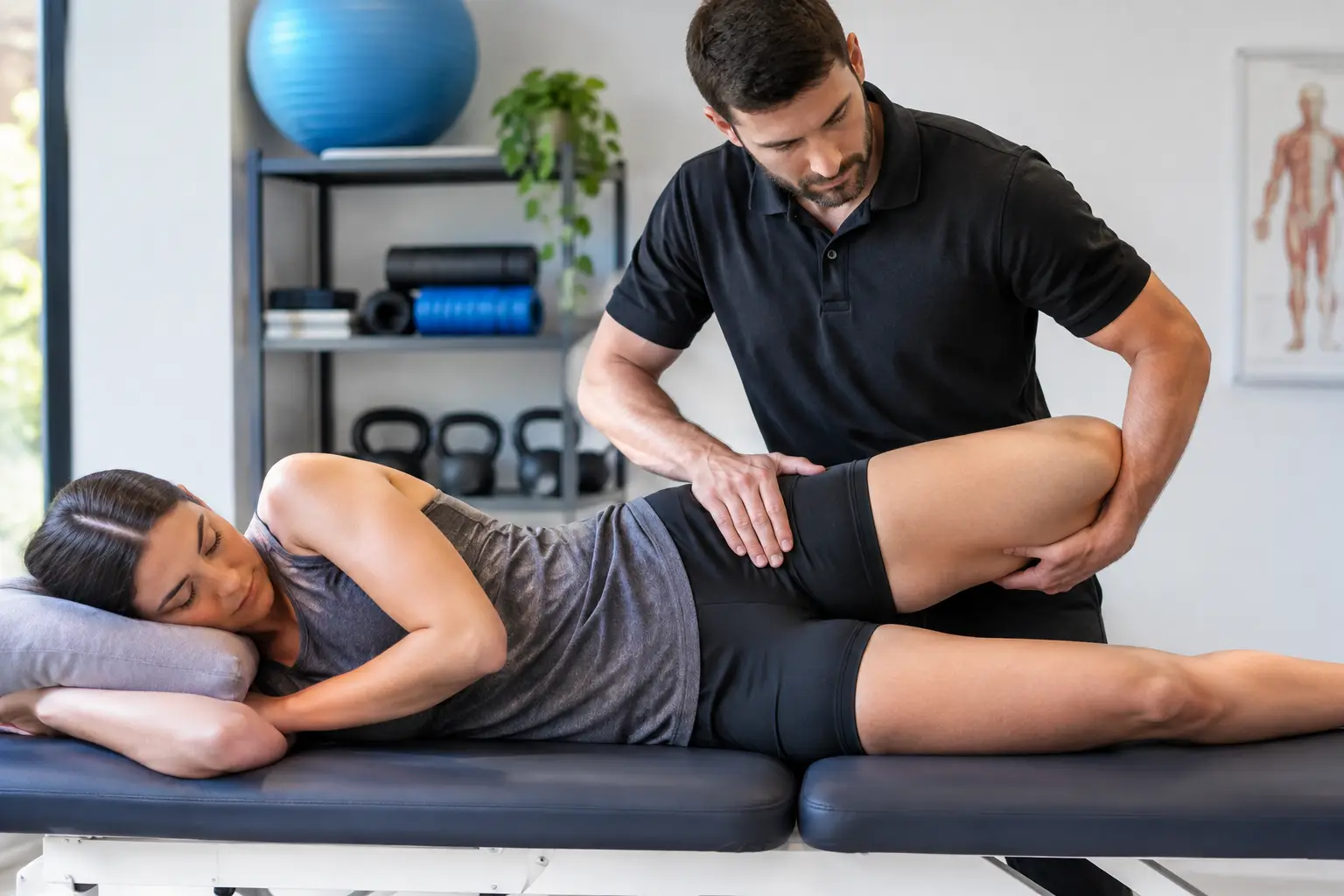
Hip pain has a way of shrinking your world. A deep ache after sitting through a meeting, a sharp pinch at the bottom of a squat, pain when getting out of the car, or discomfort that makes running and sleeping harder can quickly change how you train, work, and move.
The challenge is that hip pain is a symptom, not one diagnosis. The hip is a deep, highly loaded joint surrounded by strong muscles, tendons, and connective tissue. Pain felt at the hip can come from the joint itself, the tendons and muscles around it, the lower back, or sometimes a combination of these factors. That is why a clear assessment matters more than guessing based on one symptom.
What Hip Pain Can Feel Like
Where you feel pain offers useful clues, but it does not provide a complete diagnosis on its own. Pain in the groin or at the front of the hip may be more related to the hip joint or the hip flexor region. Pain on the outside of the hip is often associated with the tendons of the gluteal muscles or the bursa, a small fluid-filled structure that can become irritated when surrounding tissues are overloaded.
Pain in the buttock can come from the hip, but it may also be referred from the low back or involve the deep muscles around the pelvis. Some people feel a dull ache and stiffness. Others notice catching, clicking, pinching, weakness, or a sharp pain with specific movements. The pattern matters: whether symptoms started suddenly or gradually, what movements reproduce them, and how the hip responds in the following 24 hours all help guide the next step.
Hip pain commonly shows up with walking uphill, climbing stairs, prolonged standing, running, pivoting, side-lying, deep squatting, lunging, or sitting for long periods. For active adults, it may first appear as a loss of confidence under load rather than a dramatic injury. You may still be able to train, but certain movements become guarded, weaker, or unpredictable.
Common Reasons Hip Pain Develops
Hip osteoarthritis is one possible source, especially when there is progressive stiffness, groin pain, reduced tolerance for walking, or difficulty putting on socks and shoes. However, osteoarthritis is not the only explanation for a stiff or painful hip, and an X-ray finding does not automatically explain every symptom. Imaging needs to be considered alongside your movement, strength, history, and clinical presentation.
Gluteal tendinopathy is another common presentation. It typically causes pain over the outside of the hip, often worse with lying on that side, walking longer distances, climbing stairs, or standing with most of your weight shifted onto one leg. It is frequently an issue of tendon capacity and repeated compression or loading, not simply inflammation that needs complete rest.
Other possible contributors include hip flexor or adductor muscle strains, tendon irritation, hip joint impingement-related pain, labral involvement, referred pain from the lumbar spine, or symptoms following a fall or direct impact. Runners may notice symptoms after a rapid increase in mileage or hills. Lifters may notice them when training volume, depth, or load outpaces their current tolerance. Desk workers may feel stiff after long periods of sitting, then painful when they abruptly return to demanding activity.
Often, there is no single movement that caused the problem. Hip symptoms can build when workload rises faster than the tissues can adapt. That workload may be training, but it can also be repetitive work, walking on uneven ground, carrying children, climbing ladders, or a busy stretch where recovery and movement options have narrowed.
When Hip Pain Needs an Assessment
A new ache that improves steadily after a minor increase in activity may settle with sensible load reduction and gradual return to movement. Persistent, recurring, or worsening pain deserves more attention, particularly when it changes how you walk, sleep, work, or exercise.
Arrange an assessment if pain is lasting beyond a couple of weeks, keeps returning when you resume activity, causes you to avoid normal movement, or is accompanied by notable weakness, catching, or loss of hip motion. An assessment is also useful when you have tried rest, stretching, massage, or generic online exercises without a meaningful change.
Seek urgent medical attention for severe pain after a significant fall or accident, inability to bear weight, fever or feeling unwell with a hot swollen joint, unexplained weight loss, new numbness around the groin, or new bowel or bladder changes. These symptoms are less common, but they need timely medical evaluation rather than a wait-and-see approach.
A Better Assessment Looks Beyond the Painful Spot
A useful hip assessment is not limited to pressing on the sore area and naming a tissue. It starts with your story: when symptoms began, what has changed in your work or training, what aggravates and eases the pain, and what you need to get back to.
From there, a clinician can assess hip and low-back movement, walking and squat mechanics where appropriate, strength, balance, tendon and muscle loading tolerance, and specific positions that reproduce symptoms. The goal is to narrow down the most likely pain drivers while identifying what your hip can currently tolerate.
This process also helps avoid two common mistakes: treating every painful hip as the same problem, or avoiding all activity for so long that strength and confidence decline further. A runner with lateral hip pain, a tradesperson with groin pain, and a gym-goer who feels a pinch in deep flexion may all need different starting points.
Treatment for Hip Pain Should Match the Problem
Hands-on treatment can be useful when pain, muscle guarding, or stiffness is limiting your ability to move and start rehabilitation. Depending on the presentation, this may include joint mobilization or manipulation when appropriate, deep soft tissue therapy, Graston or instrument-assisted soft tissue therapy, cupping, Class IV laser therapy, or shockwave therapy for selected tendon presentations.
These treatments are not standalone cures, and they are not the whole plan. Their value is often in helping reduce symptoms enough for you to move better, load the area, and make progress with rehabilitation. If treatment feels good but does not translate into better walking, training, work tolerance, or confidence over time, the plan needs to change.
For some hip conditions, reducing an aggravating activity temporarily is sensible. That does not always mean stopping all exercise. A runner may reduce hills or total distance while maintaining strength work. A lifter may adjust squat depth, stance, tempo, or load while building tolerance. Someone with outer hip pain may need to avoid prolonged side-lying on the painful side and repeated hip-hanging positions while the tendon settles and gets stronger.
Rehabilitation Builds Capacity, Not Just Temporary Relief
The most durable part of hip rehabilitation is progressive loading. Your program should reflect the activities that matter to you, whether that is getting through a warehouse shift, walking the Rail Trail, returning to hockey, or training without second-guessing every rep.
Early rehabilitation may focus on finding movements you can perform with acceptable symptoms and good control. As tolerance improves, loading usually progresses through hip strength, single-leg control, functional movement, and task-specific work. For a runner, that may eventually include impact and running progressions. For a lifter, it may involve rebuilding depth and load in the patterns that previously caused pain.
Pain during rehab is not automatically harmful, but it should be interpreted in context. A mild, predictable symptom that settles quickly may be acceptable for some conditions. Sharp pain, escalating symptoms, limping, or a significant flare-up that lasts into the next day suggests the dose was probably too high. The right progression is challenging enough to create adaptation without repeatedly overwhelming the area.
How Ground Up Rehab Approaches Hip Problems
At Ground Up Rehab in Hamilton, the focus is on identifying what is limiting your hip, calming the immediate problem where needed, and building a plan that holds up outside the clinic. That means meaningful hands-on care when it has a role, combined with progressive rehabilitation rather than passive treatment alone.
Your plan should account for your actual demands. A parent lifting a toddler, a recreational golfer, a runner from Ancaster, and a worker on their feet all need more than a generic set of exercises. The target is not simply a less painful hip on the treatment table. It is a hip that is better prepared for the positions, loads, and activities your life requires.
If your hip pain is changing how you move, train, sleep, or work, book an assessment. A clear diagnosis is not always immediate, but a focused assessment can replace guesswork with a practical path back to stronger, more confident movement.
