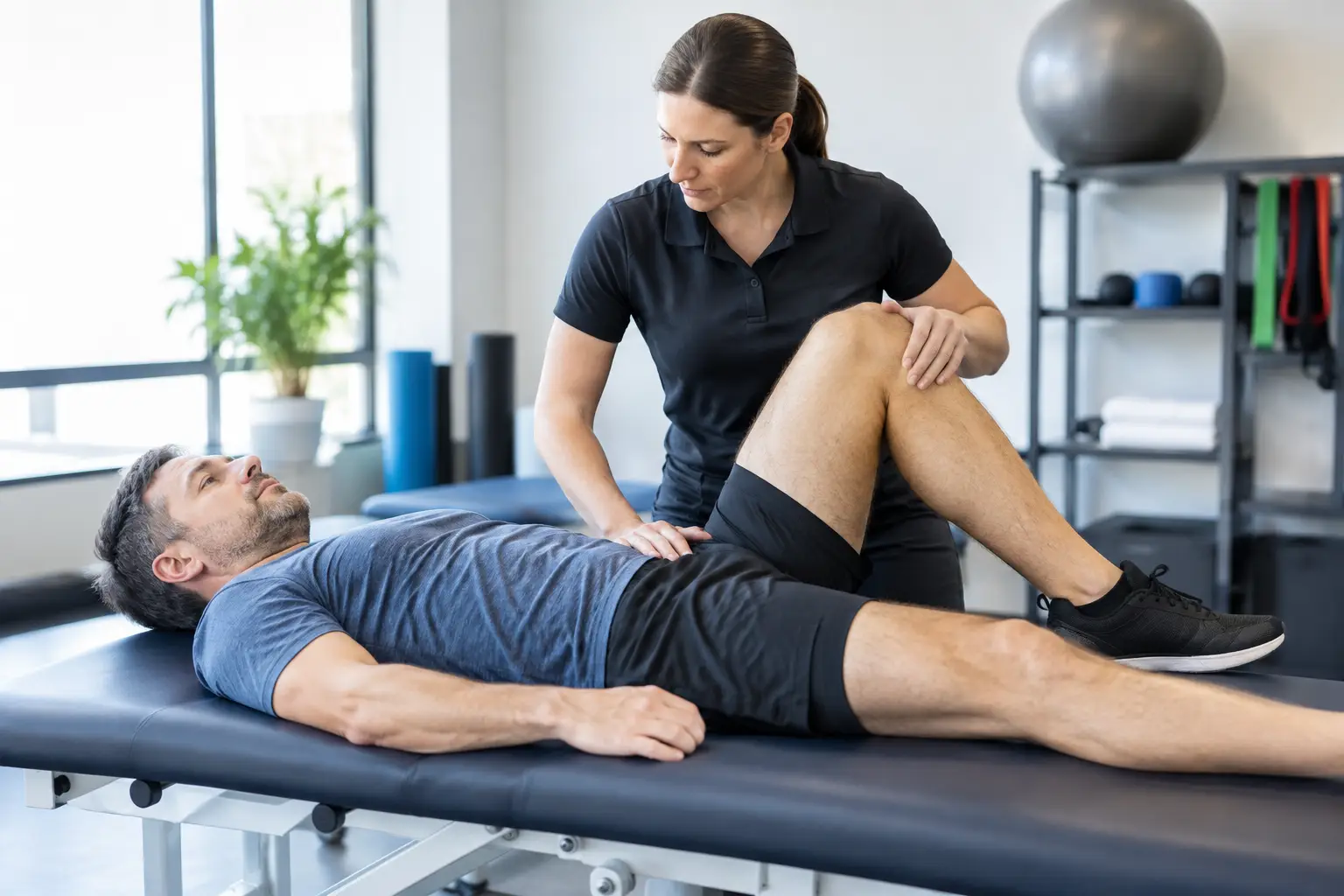
A sharp pull while changing direction, an ache after a long drive, or pain at the bottom of a squat can all be described as groin pain. But groin pain causes are not limited to a strained muscle. The groin is where the inner thigh, hip, lower abdomen and pelvis meet, so several tissues can produce very similar symptoms. Getting clear on the likely source matters because the right next step for an adductor strain is not always the right plan for hip-related pain, a hernia, or a non-musculoskeletal issue.
What counts as groin pain?
Groin pain is discomfort felt in the crease at the front of the hip, the inner thigh, the pubic area, or sometimes the lower abdomen. It may feel sharp during a specific movement, dull after activity, tight when getting out of a car, or deep inside the front of the hip.
Pain location offers useful clues, but it cannot confirm a diagnosis by itself. A runner with inner-thigh pain may have an irritated adductor tendon, while a lifter with nearly identical pain could be dealing with hip joint irritation or a load-management problem around the pelvis. A proper assessment looks at the pattern, the movements that reproduce symptoms, training and work demands, strength, mobility, and the way the hip and trunk handle load.
Common groin pain causes
Adductor muscle or tendon strain
The adductors are the muscles along the inner thigh. They help bring the leg toward the midline, stabilize the pelvis, and control cutting, skating, kicking, lunging, squatting, and changing direction. An adductor strain often happens suddenly during a wide step, sprint, kick, or awkward slip. It can also build gradually when training volume increases faster than the tissue can tolerate.
Symptoms usually sit high in the inner thigh or near the pubic bone. Squeezing the knees together, stepping sideways, accelerating, or taking a long stride may be uncomfortable. With a more irritable strain, even rolling over in bed or getting in and out of a vehicle can hurt.
Not every adductor problem needs complete rest. Early on, reducing aggravating activities can settle symptoms, but progressive strengthening is usually what restores confidence and capacity. The exact starting point depends on how reactive the area is and what you need to return to.
Hip joint-related pain
Deep groin pain is commonly associated with the hip joint. Hip osteoarthritis, femoroacetabular impingement syndrome, labral irritation, and other hip-related presentations can all create pain at the front of the hip or in the groin. Symptoms may show up with deep squats, prolonged sitting, pivoting, running hills, or putting on socks and shoes.
This does not mean a painful hip is "damaged" or that every click requires imaging. Many people have hip shape variations or labral changes without pain. What matters clinically is how your symptoms behave, whether motion is limited, which activities are affected, and whether the hip can tolerate progressive loading.
Hip-related groin pain often responds better to a plan that improves strength and control through the ranges you need than to repeatedly forcing a painful stretch. Some people need to temporarily reduce deep hip flexion or high-volume impact work while rebuilding capacity. Others can keep training with thoughtful changes to range, load, tempo, or exercise selection.
Hip flexor or rectus femoris irritation
The hip flexors lift the thigh toward the body and work hard during running, climbing stairs, kicking, cycling, and high-knee movements. Irritation in these muscles or tendons can create pain at the front of the hip that is often described as groin pain.
A hip flexor issue may develop after a sudden sprint, but it can also appear after adding hill running, intense cycling, hanging leg raises, or high-repetition core work. Pain when lifting the knee, climbing stairs, or rising from a low chair can be a clue. Because hip flexor symptoms overlap with joint-related pain, assessment is useful when the issue persists or keeps returning.
Pubic and lower abdominal overload
Pain around the pubic bone can involve the adductors, lower abdominal muscles, or the structures that transfer force between the trunk and legs. This pattern is common in sports that require repeated sprinting, cutting, kicking, and rotation, but it can also affect active adults who have rapidly changed their gym, running, or work demands.
You may notice pain with coughing, twisting, sit-ups, kicking, cutting, or hard adductor work. These cases are often called athletic groin pain, but the label is less useful than identifying which activities and tissues are sensitive. Recovery usually requires more than generic core exercises. The goal is to progressively build the ability of the trunk, hip, and adductors to manage force together.
Inguinal hernia
An inguinal hernia occurs when tissue pushes through a weak area of the lower abdominal wall. It may cause a feeling of pressure, burning, heaviness, or a visible or palpable bulge in the groin. Symptoms can be more noticeable with lifting, straining, coughing, or standing for a long time.
A hernia is not a condition to self-treat as a muscle strain. If you notice a new lump or bulge, or groin pain that is clearly linked to coughing or straining, arrange a medical assessment. A rehabilitation clinician can help identify when the presentation does not fit a straightforward musculoskeletal injury, but medical assessment is needed to diagnose and manage a suspected hernia.
Referred pain from the low back or pelvis
The low back, sacroiliac region, and nerves that travel through the pelvis can occasionally refer symptoms toward the groin. This is less common than local hip or adductor issues, but it is worth considering when groin pain occurs with back pain, buttock pain, tingling, altered sensation, or symptoms that change significantly with spinal movement.
The key is not to assume that every groin symptom is coming from the back. A thorough assessment helps distinguish local tissue sensitivity from referred symptoms, and sometimes both are contributing.
What tends to aggravate groin pain?
Groin pain often becomes persistent when someone alternates between two extremes: pushing through sharp symptoms to maintain training, then stopping all activity for weeks. Neither approach reliably rebuilds tolerance.
Common aggravators include sudden increases in running distance or speed, cutting and field sports, heavy or deep squats, wide-stance lifting, kicking, skating, hills, and repetitive twisting. Long periods of sitting may also irritate some hip-related presentations. The trigger is individual. A movement that is tolerable for one person may be the exact movement another person needs to modify temporarily.
When should groin pain be assessed?
A brief, mild ache after unfamiliar activity may settle with sensible training changes. Assessment is a good idea when pain is limiting work, sleep, walking, training, sport, or daily tasks; when it returns every time you resume activity; or when it has not meaningfully improved after a couple of weeks.
Seek urgent medical care for severe or rapidly worsening pain, fever, nausea or vomiting, a painful groin bulge, unexplained testicular pain or swelling, inability to bear weight after trauma, numbness in the saddle area, or new changes in bowel or bladder control. Those symptoms need prompt medical evaluation rather than a routine musculoskeletal appointment.
How groin pain is assessed
A useful assessment is not just a quick check of where it hurts. It starts with the story: when symptoms began, whether there was a specific injury, what loads have changed, and which positions or activities are now limited. From there, the clinician assesses hip and lumbar movement, adductor and hip flexor strength, balance, control, walking or running mechanics when relevant, and the specific tasks that bring on your pain.
This process helps narrow down the main drivers and establish a starting point. Imaging is sometimes appropriate, particularly after significant trauma, with suspected hip arthritis or stress injury, or when symptoms are not following an expected course. It is not automatically required for every case of groin pain.
Treatment and rehabilitation: build capacity, not just short-term relief
The right treatment depends on the presentation. Hands-on care such as joint mobilization, deep soft tissue therapy, or instrument-assisted soft tissue work may help reduce pain and improve short-term movement tolerance for some people. Cupping, Class IV laser therapy, or shockwave therapy may be considered in selected tendon or soft-tissue presentations. These tools are not standalone cures, and they should support a broader rehabilitation plan rather than replace one.
Progressive loading is usually the centre of recovery. For an adductor problem, that may begin with tolerable isometric squeezes and controlled adductor strengthening before advancing to lateral movement, lunges, running, and cutting. For hip-related pain, it may involve improving lower-body strength, hip control, and tolerance to the ranges required for work, lifting, or sport.
The goal is not to avoid every sensation forever. It is to find a level of activity that is challenging enough to build capacity without repeatedly flaring the problem. That often means modifying, not abandoning, training while gradually reintroducing the movements you value.
At Ground Up Rehab in Hamilton, care for groin pain starts by identifying what is actually limiting you, then building a practical plan around your work, training, and sport. If your symptoms sound familiar, book an assessment and get a clear path back to moving with confidence.
